‘Don’t Worry,’ Said the Hologram, ‘This Product is 100% Original’

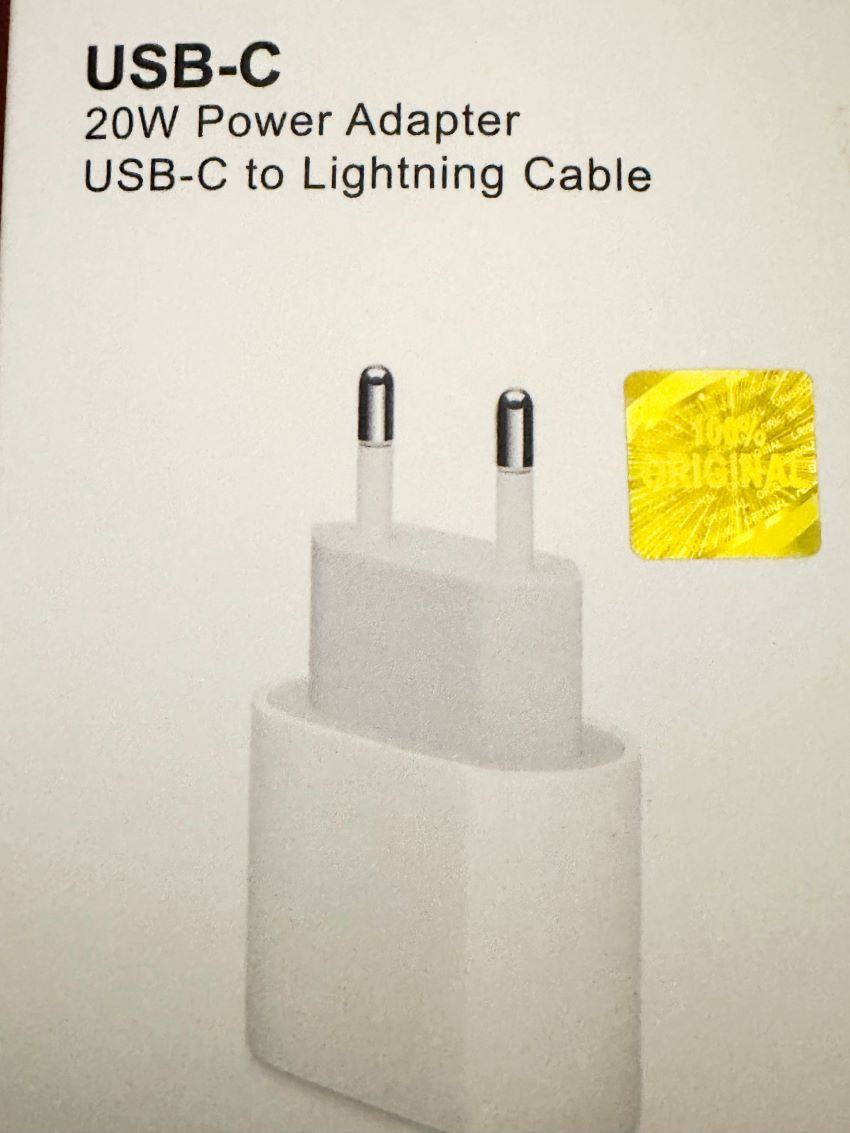
I recently made an online purchase of a 20W USB-C power adapter and cable to charge my iPhone. I recall opening the shipping box and seeing something that looked vaguely Apple-like, including white packaging and familiar design cues.
Except there was no Apple logo. In fact, there was no brand name at all. What the box did have on it, however, was a flashy gold hologram proudly proclaiming the product to be ‘100% Original’.
And, I have to admit, I found that reassuring, even though a subsequent online search for the manufacturer of this product warned me to be wary of such holograms.
Now, ‘100% Original’ is an interesting claim when you think about it. Original what?
Original compared with what? Original according to whom? A product without a manufacturer, a logo or even a name somehow seeks legitimacy through a shiny sticker.
As someone who spends most of their working life writing about authentication technologies, secure tax stamps and anti-counterfeiting systems, I should know better. Yet there I was, plugging this anonymous charger into my iPhone and hoping that the phrase ‘100% Original’ translated into ‘unlikely to burst into flames’.
Several weeks later, I am happy to report that neither the charger nor the phone has exploded. The charger works perfectly well. Perhaps it came from the same factory that supplies the branded versions. Perhaps it is genuinely high quality. Or perhaps I simply fell victim to the same psychological cues that marketers and counterfeiters alike have exploited for decades.
Because that’s the thing about trust. We often don’t verify it; we infer it. We take comfort from visual signals – a hologram, a seal, a familiar shape, a badge proclaiming ‘Premium Quality’ or ‘Certified Genuine’.
But stripped of context, such features tell us remarkably little.
This raises an uncomfortable question for the authentication industry itself.
Holograms have long been classified as an overt security feature – one that is visible to anyone and intended to assist in authentication. Brand owners have spent decades placing holograms on products, based on this assumption.
Yet my charger demonstrates the weakness in that logic. The hologram may have looked impressive, but I had absolutely no way of knowing whether it was genuine, copied, authorised or entirely fictional. I had nothing against which to compare it. In reality, I wasn’t authenticating the product at all. I was simply responding to a visual cue that suggested authenticity.
If consumers cannot distinguish a genuine hologram from a counterfeit one, then the hologram is not functioning as an effective consumer authentication tool. Instead, it risks becoming little more than a trust signal.
A hologram by itself is not authentication. A QR code by itself is not traceability.
Even the latest AI-powered security technology means little unless it forms part of a system backed by trusted data and a trusted issuer.
The great paradox
This is one of the great paradoxes of the authentication industry. Security features are not valuable simply because they look secure. Their value lies in their ability to support a trusted verification process and connect users to reliable information about a product’s authenticity.
The problem, therefore, is rarely the hologram itself. The real challenge lies in implementation. Even the most sophisticated security feature can lose much of its value if it is not securely integrated into the product or packaging, supported by an appropriate verification process and deployed in a way that users can understand and trust.
This challenge is particularly evident in brand protection, where few universal standards govern the specification, placement and application of authentication labels. As a result, even technically sophisticated security features may be deployed in ways that make meaningful authentication difficult for consumers.
By contrast, many of the same technologies have proven highly effective in high-security documents, banknotes and tax stamps, where they are implemented according to defined specifications and supported by established inspection and verification procedures. The difference is often not the technology itself, but the framework in which it operates.
The lesson: make verification easier
The lesson is not that holograms are ineffective. Far from it. Modern holograms remain difficult to reproduce accurately and continue to play an important role in layered security strategies. But, increasingly, they need to be supported by systems that allow users to verify, rather than simply assume, authenticity.
Rather than expecting consumers to authenticate products solely through visual inspection, the industry may need to focus on making verification easier and more meaningful. That could involve smartphone-based authentication, links to authoritative databases, consumer education or security features that generate a trusted digital response when scanned. The objective should not simply be to make products look authentic, but to allow users to confirm authenticity with confidence.
In other words, the future of authentication may lie less in asking consumers to trust what they see, and more in helping them verify what they see.
Which brings me back to my mysterious charger. It may well be perfectly legitimate. But I cannot help wondering whether I was reassured by the engineering inside the box, or by a little gold sticker outside it.
And if someone who writes about authentication for a living can be fooled by that distinction, perhaps the industry still has some work to do.
Get the TSAN Weekly News delivered free to your inbox.